You can speak with experienced attorneys who have secured over $7.5 billion in negotiated settlements for injured clients by calling 314-963-9000 for a free consultation with no fees unless we win your case. You may still be entitled to significant compensation under Missouri law even if you share responsibility for your accident. Learn how comparative negligence affects your recovery and what you need to know about fault determination.
What Is Comparative Negligence?
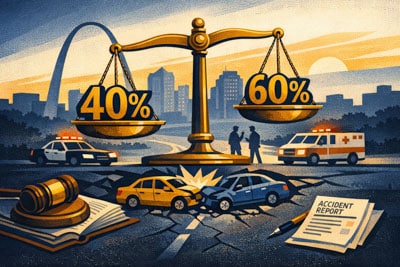
Understanding how Missouri handles shared fault begins with a simple but powerful principle. Missouri follows a pure comparative negligence system, which means you may recover compensation even if you share substantial responsibility for your accident, though your recovery will be reduced by your percentage of fault.
How Pure Comparative Negligence Works
Under this legal framework established by the Missouri Supreme Court in Gustafson v. Benda, 661 S.W.2d 11 (Mo. banc 1983), a person who is 30% at fault for an accident causing $100,000 in damages could recover $70,000, while someone 80% at fault could still recover $20,000. This system differs significantly from neighboring Illinois, where anyone more than 50% at fault cannot recover any compensation at all, making Missouri’s approach more favorable to injured victims who may have contributed to their accidents.
The Critical Question of Fault Determination
The critical question becomes not whether you can recover, but rather how your fault percentage is determined and who makes that determination—questions that directly impact the compensation you may be able to secure for your injuries, lost wages, and other damages. These determinations happen at multiple stages of your case, from initial insurance adjustments through potential trial proceedings, and understanding who has authority at each stage helps you protect your interests throughout the process.
Who Determines Your Fault Percentage in a Missouri Car Accident?
The determination of fault percentages in Missouri car accidents involves multiple decision-makers at different stages of your case. Understanding who has authority at each stage helps you protect your interests throughout the process, from the initial insurance investigation through potential trial proceedings.
Insurance Adjusters
Initially, insurance adjusters make preliminary fault assessments that influence settlement offers. According to Insurance Research Council data (2023), these determinations occur in approximately 95% of cases that settle without litigation, though they are not legally binding. These adjusters work for insurance companies with financial incentives to minimize payouts, and they often inflate your fault percentage to reduce their company’s liability, which is why their initial assessments should be viewed skeptically and challenged when appropriate.
Attorneys During Settlement Negotiations
When attorneys become involved, the fault determination process becomes more balanced as competing assessments based on evidence emerge. Your attorney presents evidence to minimize your fault while the defense attempts to maximize it, creating a negotiation dynamic where the strength of available evidence, witness credibility, and the likelihood of success at trial all influence the final fault apportionment. During settlement negotiations, which resolve most car accident cases in Missouri, attorneys negotiate fault percentages based on these factors rather than accepting the insurance company’s initial assessment.
Judge or Jury at Trial
If your case proceeds to trial, a jury or judge becomes the ultimate authority on fault apportionment. Using jury instructions that require them to assign specific percentages to each party based on the preponderance of evidence presented, jurors evaluate witness testimony, physical evidence, expert opinions, and all other relevant factors to determine how responsibility should be divided. Throughout this multi-stage process, your fault percentage can change as new evidence emerges or different decision-makers evaluate the case, making early and thorough documentation crucial to protecting your rights and ensuring the most favorable outcome possible.
Fault Percentage Changes as Evidence Emerges
Your fault percentage is not static throughout your case. As new evidence emerges, is analyzed, and presented by different parties at different stages, your assigned fault percentage can shift significantly. This is why immediate evidence preservation after an accident is critical—evidence collected within days or weeks of the collision is more reliable than evidence reconstructed months later. Understanding that your fault percentage can be negotiated, challenged, and revised throughout your case gives you opportunity to minimize responsibility through strategic presentation of evidence and expert testimony.
The Evidence That Determines Fault Percentages
Why does one accident victim receive full compensation while another with similar injuries receives only a fraction? The answer lies in the evidence used to establish fault percentages, which ranges from official documentation to electronic data. Understanding the relative weight of each type helps you build the strongest possible case from the moment the collision occurs.
Official Documentation and Physical Evidence
Police reports and official documentation, while influential in fault determinations, are not conclusive proof of fault percentages. Officers often arrive after the accident and base their reports on limited information and preliminary observations, which means their conclusions can be challenged with more complete evidence. Physical evidence from the accident scene provides objective data that accident reconstruction experts can analyze to determine factors like speed, direction of travel, and point of impact—including vehicle damage patterns, skid marks, debris fields, and the final resting positions of vehicles.
Witness Testimony and Electronic Evidence
Witness testimony carries significant weight in fault determinations, particularly when independent witnesses with no connection to either party provide consistent accounts of what they observed. However, conflicting witness statements often require juries to assess credibility, weighing factors like the witness’s vantage point, attention to the scene, and consistency with physical evidence. Electronic and video evidence has become increasingly important in modern accident cases, with dashcam footage, surveillance cameras, cell phone records proving distraction, and vehicle event data recorders (black boxes) providing objective data that can definitively establish or refute fault allegations. According to MoDOT data (2024 preliminary), traffic camera footage may be available at major intersections throughout St. Louis, though this evidence must be requested quickly before automatic deletion occurs.
Expert Analysis and Reconstruction
When physical evidence and witness accounts conflict, expert analysis from accident reconstruction specialists, biomechanical engineers, and human factors experts becomes necessary to establish how the accident occurred and apportion fault appropriately. These experts use scientific methods to analyze the available evidence, create detailed reconstructions of the accident sequence, and provide testimony that helps juries understand complex technical aspects of fault determination. The strategic presentation of this evidence becomes even more critical when insurance companies employ tactics to unfairly increase your assigned fault percentage, using their own experts and selective interpretation of evidence to minimize their financial exposure. The availability and preservation of this evidence can make the difference between a disputed fault scenario and clear liability, which is why immediate action after an accident is so critical to protecting your rights.
How Insurance Companies Try to Inflate Your Fault Percentage
Insurance adjusters employ sophisticated tactics designed to increase your fault percentage and reduce their company’s payout. Understanding these strategies before giving any statements or accepting settlement offers protects you from inadvertently damaging your own case through seemingly innocent cooperation with the investigation process.
Recorded Statement Tactics
During recorded statements, adjusters ask carefully crafted questions designed to elicit admissions that sound like acceptance of fault. For example, “How fast were you going?” is a question where any answer can be twisted to suggest you were driving too fast for conditions, while “Did you see the other vehicle?” implies you should have been able to avoid the accident regardless of the other driver’s actions. These seemingly innocent questions create a minefield where honest answers get weaponized against you, particularly when adjusters selectively quote portions of your statement out of context during later negotiations.
Delay and Pressure Tactics
Insurance companies often delay investigating or processing claims until your medical bills mount and financial pressure builds, then present quick settlement offers that include inflated fault percentages you might accept out of desperation. They selectively emphasize evidence supporting their fault theory while ignoring or minimizing contradictory evidence, creating a skewed narrative that makes you appear more responsible than the actual facts support. Some adjusters even misrepresent Missouri’s pure comparative negligence law, falsely claiming there’s a threshold that bars recovery or suggesting that any fault on your part eliminates certain types of damages.
How Legal Representation Changes the Dynamic
The presence of experienced legal representation changes this dynamic significantly. Insurance companies know that attorneys recognize these tactics, conduct independent investigations, understand how to present evidence favorably, and have the resources to involve experts when necessary to counter inflated fault allegations. Our team at OnderLaw has decades of experience identifying and defeating these tactics, using our knowledge of insurance company practices and willingness to take cases to trial as leverage to ensure fair fault determinations. Understanding how comparative negligence applies to specific accident scenarios helps illustrate why skilled legal representation matters in protecting your rights and maximizing your potential recovery.
Common Car Accident Scenarios
The application of comparative negligence principles varies significantly depending on the type of accident. Understanding these patterns helps predict how fault might be apportioned in your specific case, though every accident involves unique facts that can shift percentages significantly.
Rear-End Collisions: Missouri law typically presumes the following driver is at fault for failing to maintain safe following distance. However, this presumption can be overcome with evidence of sudden stops without cause, brake light failures, or the lead vehicle reversing, potentially resulting in fault splits that may range from 90/10 to 80/20 when both drivers share responsibility.
Intersection Accidents: Intersection accidents often involve complex right-of-way disputes where both drivers claim to have had a green light or dispute who arrived at a stop sign first, with typical fault apportionments that may range from 50/50 in genuinely disputed signal cases to 70/30 when one driver clearly violated right-of-way rules but the other could have avoided the collision.
Lane Change and Merge Accidents: Lane change and merge accidents require careful analysis of each driver’s duty to ensure safe lane changes. Comparative negligence may apply when both vehicles change lanes simultaneously or when questions arise about blind spot awareness versus failure to signal, typically resulting in fault splits that could range from 60/40 to 80/20 depending on the specific circumstances.
Left-Turn Accidents: Left-turn accidents generally place primary fault on the turning driver who failed to yield to oncoming traffic, though comparative negligence may reduce this when the oncoming driver was speeding excessively or ran a red light, with fault percentages that could range from 80/20 to 100/0 depending on the oncoming driver’s contributory actions.
Parking Lot Accidents: Parking lot accidents present unique challenges because private property rules and equal duties of care often result in 50/50 fault splits, particularly when both drivers were backing up or disputing right-of-way in unmarked travel lanes. These typical patterns provide general guidance, but every accident involves unique facts that can shift fault percentages significantly, making thorough investigation and evidence preservation essential to achieving fair fault apportionment.
Multiple Defendants and Joint and Several Liability in Missouri
When multiple parties contribute to causing your accident, Missouri law requires separate fault percentage determinations for each defendant while still reducing your recovery by your own percentage of fault. This creates complex calculations that significantly impact your compensation, particularly when dealing with defendants who have different levels of financial resources or insurance coverage.
Example Calculation: In a three-car accident where Defendant A is 50% at fault, Defendant B is 30% at fault, and you are 20% at fault, you may recover 80% of your total damages, with that amount split between the defendants based on their respective fault percentages.
Joint and Several Liability (RSMo § 537.067): Under Missouri’s joint and several liability statute, any defendant found to be 51% or more at fault becomes jointly and severally liable for your entire judgment, meaning they can be required to pay the full amount even if other defendants cannot pay their shares. This protection becomes crucial when dealing with underinsured or uninsured defendants, as the defendant with majority fault cannot escape liability by pointing to other defendants’ inability to pay their proportionate shares.
Severally Liable Defendants: Defendants with less than 51% fault remain only severally liable for their proportionate share, meaning they cannot be forced to cover other defendants’ portions even if those defendants lack insurance or assets to satisfy the judgment.
Strategic Advantages: Strategic considerations in multi-defendant cases often work to your advantage, as defendants may point fingers at each other during litigation, providing evidence that reduces your assigned fault percentage while they attempt to shift blame among themselves. Understanding how expert witnesses influence these fault determinations becomes essential when dealing with complex multi-party accidents or disputed liability scenarios, as their testimony can make the difference between a favorable settlement and an unfair apportionment of responsibility.
The Role of Expert Witnesses in Proving or Reducing Fault
Expert witnesses provide crucial testimony that can dramatically impact fault determinations, particularly in cases where physical evidence is limited, witness accounts conflict, or technical analysis is required to understand how an accident occurred. Their scientific analysis transforms disputed facts into objective conclusions that carry significant weight with insurance adjusters, opposing counsel, and juries.
Accident Reconstruction Experts
Accident reconstruction experts analyze physical evidence including vehicle damage, skid marks, and debris patterns to calculate speeds, determine impact angles, establish reaction times, and create demonstrative evidence like diagrams and animations that help juries visualize exactly how the accident unfolded. These experts become particularly valuable in complex multi-vehicle accidents, disputes about traffic signal timing, or cases where no independent witnesses observed the collision, providing scientific analysis that transforms conflicting accounts into objective determinations based on physics and engineering principles.
Human Factors Experts
Human factors experts examine driver perception-reaction times, visibility conditions, and cognitive limitations that affect driver behavior, while biomechanical experts analyze injury patterns to determine whether claimed injuries are consistent with the accident dynamics and forces involved. These experts help explain why a driver may not have been able to avoid a collision even if they saw it coming, or establish the force of impact based on injury severity and type.
Industry Standards Experts
Industry standards experts become relevant in commercial vehicle accidents where Federal Motor Carrier Safety Administration regulations apply, or in cases involving alleged vehicle defects where manufacturing standards and safety requirements establish the applicable standard of care. These experts provide testimony that establishes what a reasonable driver in the defendant’s position should have done under the circumstances, and whether the defendant’s conduct deviated from industry standards and reasonable care.
Strategic Importance of Expert Testimony
The strategic use of expert testimony often determines whether your fault percentage remains low enough to preserve substantial compensation, making their involvement a critical investment in cases with significant damages or disputed liability that could dramatically affect your recovery. Expert witnesses can transform seemingly ambiguous physical evidence into clear proof of what happened, counter insurance company experts employed by the defense, and provide testimony that helps juries understand complex technical aspects of accident causation and fault apportionment.
Settlement Negotiations and Documenting Your Case
Settlement negotiations in comparative negligence cases revolve around competing fault assessments, with even small percentage differences translating to thousands of dollars in disputed compensation. The strength of your evidence directly impacts negotiating leverage.
Settlement Negotiations and Leverage
Insurance companies become more flexible on fault percentages when faced with compelling evidence that would likely persuade a jury to assign minimal fault to the plaintiff, including independent witness testimony, video footage, expert reconstruction analysis, and documentation of the defendant’s clear violations of traffic laws or duties of care. Your attorney’s role during negotiations involves strategically presenting evidence to minimize your fault percentage, countering defense arguments with expert opinions and witness testimony, and demonstrating a willingness to proceed to trial if the insurance company refuses to offer fair compensation based on realistic fault apportionment. The credible threat of trial often motivates more reasonable settlement offers, as insurance companies know that juries may be sympathetic to injured plaintiffs and could assign even lower fault percentages than those proposed during negotiations.
Documenting Your Case to Minimize Fault
Effective documentation starting immediately after your accident provides the foundation for minimizing your fault percentage. Evidence quality deteriorates and memories fade rapidly in the days and weeks following a collision, making immediate action critical to preserving the information that will ultimately determine how responsibility is apportioned. At the accident scene, photograph everything from multiple angles including all vehicle damage, the overall accident scene showing positions and road conditions, traffic control devices, weather conditions, skid marks, and any visible injuries, while also recording video to capture the broader context of traffic flow and visibility issues. Obtain complete contact information from every witness, asking them to briefly describe what they saw while their memories remain fresh, and write down your own recollection of events before trauma and time cloud your memory of important details. Throughout your case, maintain consistent medical treatment, keep a detailed injury journal, and preserve all electronic evidence including photos, texts, emails, and social media posts, being careful not to post anything that could be misinterpreted by insurance companies.
Frequently Asked Questions About Comparative Negligence in Missouri
Understanding Missouri’s comparative negligence law raises many questions for accident victims trying to evaluate their cases. These answers address the most common concerns we hear from clients navigating fault determination and settlement decisions.
Can I still recover compensation if I was mostly at fault for the accident?
Yes, Missouri’s pure comparative fault rule allows recovery even if you bear primary responsibility for the accident, with your compensation reduced by your fault percentage regardless of how high it may be. For instance, if you’re found 80% at fault for an accident causing $50,000 in damages, you could still recover $10,000 representing the 20% of damages attributable to the other party’s fault. This differs significantly from Illinois where being 51% or more at fault completely bars any recovery, making Missouri’s system more favorable for accident victims who share substantial responsibility. Having experienced legal representation becomes even more crucial in high-fault cases, as skilled negotiation and evidence presentation can reduce your assigned percentage and preserve more compensation.
How long does it take to determine fault percentages?
Initial insurance adjuster assessments typically occur within days to weeks of the accident, though these preliminary determinations often favor the insurance company and shouldn’t be accepted as final without challenge. Attorney investigations and development of counter-assessments take several weeks to months depending on evidence complexity, availability of witnesses, and whether expert analysis is required to reconstruct the accident or challenge the insurance company’s version of events. Settlement negotiations involving fault percentage disputes commonly extend over several months as parties exchange evidence and negotiate based on evolving assessments of liability, while cases that proceed to trial typically see final fault determination by a jury 12-18 months or more from the accident date, though fault percentages may be revised multiple times as new evidence emerges throughout the case.
What if the other driver and I disagree about what happened?
Conflicting accounts about how an accident occurred are common in comparative negligence cases, making objective evidence like police reports, independent witness statements, physical evidence, and video recordings crucial for resolving disputes. When accounts conflict, accident reconstruction experts may be necessary to analyze physical evidence and provide scientific opinions about how the collision occurred and who bears primary responsibility, using principles of physics and engineering to determine factors like speed, braking, and impact dynamics. These disputes don’t prevent recovery under Missouri law; instead, they become credibility determinations for the jury if the case goes to trial, with jurors weighing each party’s testimony against the objective evidence. This reality underscores why immediate evidence gathering after an accident is so critical to protecting your rights when memories are fresh and evidence remains available for documentation and preservation.
Does getting a traffic ticket mean I’m automatically at fault?
No, receiving a traffic citation provides evidence of fault but doesn’t conclusively establish your percentage of responsibility for the accident. Tickets can be challenged, dismissed, or may not tell the complete story of what occurred, particularly when the officer arrived after the collision and based the citation on limited information or statements from the other driver. Even if a citation stands, Missouri’s comparative negligence system still applies, meaning the other driver may share fault despite your traffic violation if they could have avoided the accident or contributed through their own negligent actions. For example, if you received a speeding citation but the other driver ran a red light, both parties may share fault with percentages determined by each party’s contribution to causing the collision. Your attorney can minimize the impact of a traffic citation on your fault percentage by presenting evidence of the other party’s contributory negligence and demonstrating that your violation was not the sole or primary cause of the accident.
Take Action: Protect Your Rights Under Missouri’s Comparative Negligence Law
Evidence crucial to establishing fault percentages disappears quickly after accidents. Surveillance footage gets overwritten, skid marks fade, and witness memories become less reliable with each passing day, making immediate action essential to preserving the information that will ultimately determine your compensation. Insurance companies begin building their fault case immediately after notification of your accident, gathering evidence and taking statements designed to maximize your fault percentage and minimize their payout obligations. Early attorney involvement provides critical protection during this vulnerable time, ensuring evidence is properly preserved, statements are carefully managed, and your fault percentage is minimized through strategic case development that anticipates and counters the insurance company’s tactics. Contact OnderLaw today for a free consultation to evaluate your case and understand how Missouri’s comparative negligence law affects your potential recovery.
✓ No Upfront Costs ✓ 24/7 Available✓ $5B+ Recovered