
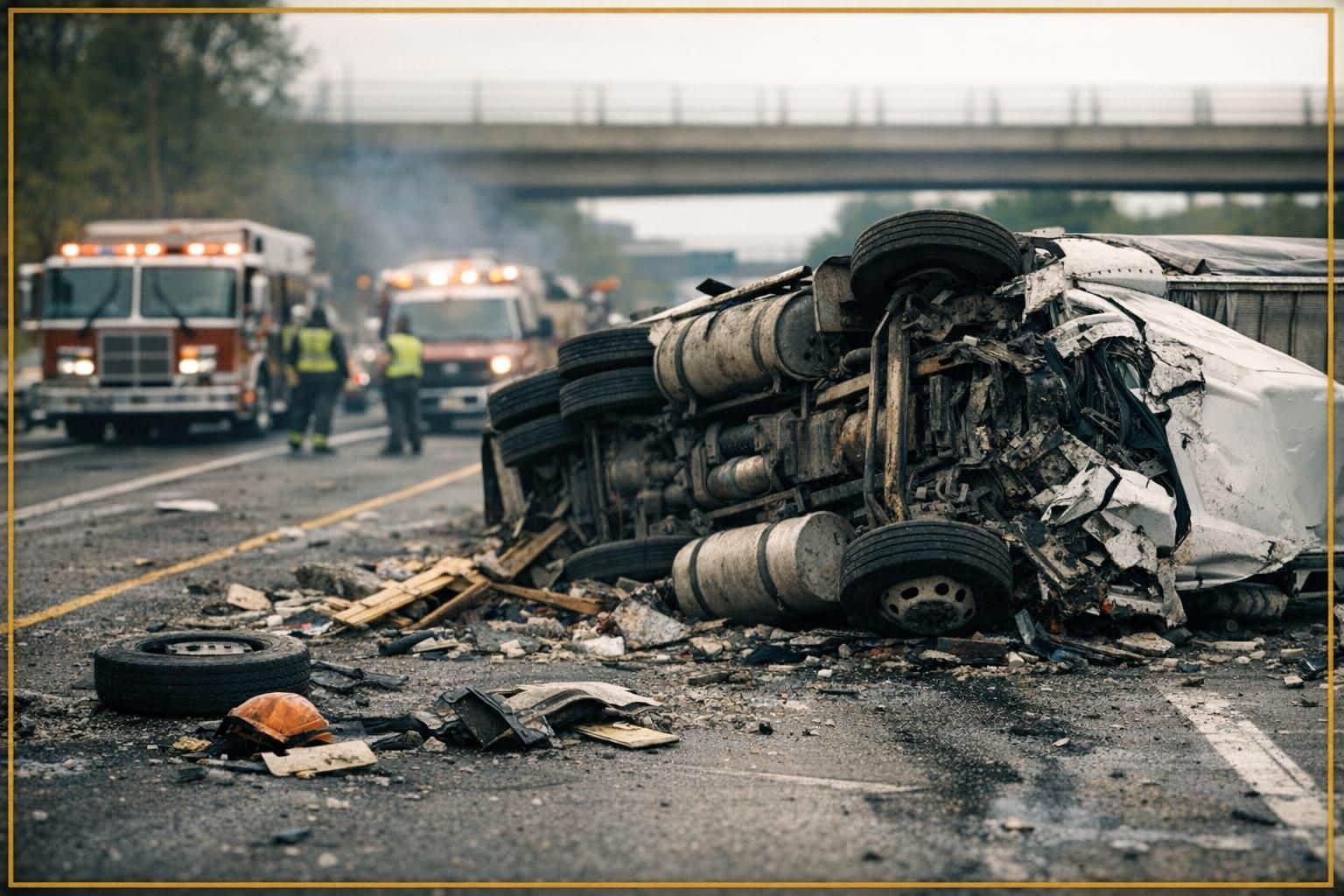
You can speak with experienced attorneys who have secured over $7.5 billion in negotiated settlements for injured clients by calling 314-963-9000 for a free consultation with no fees unless we win your case. If you’ve been injured in a rollover truck accident, you’re facing overwhelming medical bills, lost wages, and pressure from insurance companies. You need immediate help and deserve to know your rights.
Why Rollover Truck Accidents Are Catastrophic
Rollover truck accidents are among the most catastrophic crashes on Missouri and Illinois highways. When an 80,000-pound commercial vehicle loses stability and tips onto its side or roof, the results are devastating—not just for the truck driver, but for everyone sharing the road.
Disproportionately Deadly Crashes
According to the National Highway Traffic Safety Administration (NHTSA, 2023), 53% of truck occupant deaths occur in rollovers, making these crashes disproportionately deadly compared to other accident types.
Multiple Defendants & Federal Rules
Unlike passenger vehicle accidents, truck accident cases involve layers of federal regulations, corporate defendants, and specialized evidence that require immediate preservation. Understanding liability and evidence is critical to protecting your claim.
Time-Sensitive Evidence Preservation
Electronic logging devices, black box data, and witness statements can disappear within hours. Trucking companies have teams working immediately to minimize liability. You need an attorney who can match their resources and preserve critical evidence before it’s lost forever.
The Physics Behind Truck Rollover Accidents
The center of gravity on a loaded semi-truck sits much higher than passenger vehicles, creating an inherent stability challenge. Think of it like balancing a tall stack of boxes versus a single box—the taller stack tips more easily, especially when external forces are applied. When a truck’s center of gravity shifts beyond its stability threshold, gravity takes over and the vehicle rolls, often with devastating consequences.
Improper Cargo Loading & Shift Risk
Load distribution plays a critical role in rollover risk and is often a key factor in determining liability. When cargo isn’t properly secured or balanced, it shifts during normal driving maneuvers, creating a dangerous situation that can develop suddenly. According to NHTSA (2023), improper cargo loading contributed to 15% of all large truck crashes, with rollovers representing a significant portion of these incidents.
Speed as a Critical Risk Factor
Speed amplifies every risk factor. Commercial drivers must reduce speed well below posted limits, especially when fully loaded, but the pressure to maintain schedules often overrides safety considerations. According to the Federal Motor Carrier Safety Administration (FMCSA, 2023), speed-related factors contribute to nearly 30% of all large truck crashes, with excessive speed for conditions being the most common violation in rollover accidents.
Unforgiving Physics = Prevention Critical
The physics are unforgiving: a truck traveling at highway speeds that begins to tip cannot be saved by driver input alone. Once the rollover sequence begins, the massive weight and momentum make recovery impossible, which is why prevention through proper loading, appropriate speed, and driver training is so critical—and why violations of these standards constitute clear negligence.
Common Causes of Rollover Truck Accidents in St. Louis
Rollover accidents result from multiple risk factors, often acting together. Understanding what causes these crashes is essential to proving liability and holding responsible parties accountable.
Driver Error and Negligence
Driver mistakes cause the majority of rollover truck accidents. Taking curves too fast, especially on highway ramps and interchanges like those on I-70, I-64, and I-270 around St. Louis, creates lateral forces that exceed the truck’s stability threshold.
Overcorrection represents another common driver error. When a truck drifts toward the shoulder or another lane, an inexperienced or fatigued driver may jerk the steering wheel too aggressively, causing the trailer to whip and the entire vehicle to roll.
Under Missouri’s hands-free law (RSMo §304.822, effective August 28, 2023), all drivers are now prohibited from using handheld electronic devices while driving.
Hours of Service Violations & Fatigue
Federal regulations limit how long truck drivers can operate their vehicles without rest, but violations remain common. Under 49 CFR Part 395, drivers are limited to 11 hours of driving after 10 consecutive hours off duty, and they cannot drive beyond the 14th hour after coming on duty.
Electronic Logging Devices (ELDs) now track driver hours automatically, making it harder for drivers and companies to falsify logbooks. However, some carriers still pressure drivers to exceed legal limits or manipulate ELD data.
Improper Cargo Loading & Securement
How cargo is loaded and secured directly affects a truck’s stability. Weight must be distributed evenly across the trailer, with heavier items placed low and toward the center. When loaders place heavy cargo too high or concentrate weight on one side, they create an unstable configuration that makes rollovers far more likely.
Federal regulations under 49 CFR Part 393 establish specific requirements for cargo securement, including the number and type of tie-downs required based on cargo weight and characteristics. Violations of these regulations constitute negligence and provide a clear basis for liability.
Mechanical Failures & Poor Maintenance
Tire blowouts can trigger rollover accidents, especially when they occur on steering axles or when drivers overcorrect in response to the sudden loss of control. Trucking companies are required to maintain detailed inspection and maintenance records under federal regulations.
Brake failures are particularly dangerous because they prevent drivers from slowing appropriately for curves, grades, and traffic conditions. Suspension and steering system failures can cause sudden loss of control that leads directly to rollovers.
Dangerous Road Conditions & Multiple Liable Parties
While driver and company negligence cause most rollover accidents, dangerous road conditions and defective truck components can also contribute to liability. Understanding all potentially responsible parties is essential to maximizing your recovery.
Road Design & Government Liability
Poorly designed highway ramps and interchanges can create rollover hazards, especially when advisory speed limits are inadequate or missing. While Missouri law provides some immunity for road design decisions made before 1977, dangerous conditions that develop after construction can create liability for government entities under RSMo §537.600.
Weather conditions like rain, ice, and high winds require drivers to reduce speed significantly, but many truck drivers fail to adjust appropriately. While weather itself isn’t negligence, failing to reduce speed for weather conditions is.
Complex Defendant Liability Networks
Rollover truck accidents often involve multiple defendants, each with different insurance policies and legal defenses. The truck driver bears primary responsibility for safe operation, but their employer—the trucking company—is typically liable under respondeat superior doctrine.
Cargo loading companies, truck and parts manufacturers, and maintenance contractors who performed substandard repairs can all be held liable when their negligence contributed to the rollover.
FMCSA Violations Prove Negligence
Violations of Federal Motor Carrier Safety Regulations (FMCSRs) are admissible as evidence of negligence in Missouri and Illinois state courts. Key regulations include Hours of Service (49 CFR Part 395), Driver Qualifications (49 CFR Part 391), Vehicle Maintenance (49 CFR Part 396), and Drug and Alcohol Testing (49 CFR Part 382).
Insurance Coverage & Comparative Fault in Rollover Cases
⚖️️ Insurance Coverage Complexities
Federal regulations require minimum insurance coverage of $750,000 for most interstate freight carriers under 49 CFR §387.9, with higher minimums for hazardous materials. However, many carriers carry excess or umbrella policies with limits of $1 million to $5 million or more.
The MCS-90 endorsement is a federal requirement that guarantees minimum coverage will be available even if the carrier’s primary policy has exclusions or has been cancelled. Multiple policies may apply when multiple parties share liability.
⚡
Seat Belt Defense Limitation:
Missouri law under RSMo §307.178 strictly limits the seat belt defense. If proven by expert evidence to have contributed to injuries, it may reduce recovery by a statutory maximum of 1% of damages attributable to injuries that would have been prevented by seat belt use.
Evidence Critical to Proving Rollover Truck Accident Claims
Winning your case requires a comprehensive collection and analysis of multiple evidence types. We immediately preserve electronic data, document accident scenes, obtain regulatory records, and work with expert witnesses to build an overwhelming case against the defendants.
Injuries Common in Rollover Truck Accidents
Traumatic Brain Injuries
The violent forces in a rollover cause occupants’ heads to strike interior surfaces, windows, or the ground if ejected. Even when wearing seat belts, the rotational forces can cause the brain to twist inside the skull, resulting in diffuse axonal injury—one of the most severe forms of traumatic brain injury.
Symptoms may not appear immediately. Headaches, confusion, memory problems, mood changes, and difficulty concentrating can all indicate traumatic brain injury requiring immediate treatment.
Spinal Cord Injuries and Paralysis
The crushing and twisting forces in rollover accidents frequently cause spinal cord injuries ranging from incomplete injuries with partial function loss to complete injuries resulting in paraplegia or quadriplegia.
Lifetime costs for spinal cord injury victims can exceed $5 million, including emergency treatment, rehabilitation, adaptive equipment, home modifications, ongoing medical care, and assistance with daily living.
Orthopedic Injuries
Broken bones are common in rollover accidents, ranging from simple fractures that heal with casting to complex fractures requiring surgical repair with plates, screws, and rods. The most serious fractures involve the pelvis, femur, and spine.
Crush injuries occur when occupants are trapped as the truck cab collapses during the rollover. These injuries can damage muscles, nerves, and blood vessels, sometimes requiring amputation.
Internal Injuries and Organ Damage
Blunt force trauma during rollovers can cause internal bleeding, organ lacerations, and other life-threatening injuries that may not be immediately apparent. The liver, spleen, kidneys, and lungs are particularly vulnerable.
Delayed symptoms include abdominal pain, shortness of breath, dizziness, and signs of shock. These injuries can be fatal if not promptly diagnosed and treated.
⚖️
Psychological Trauma:
The terror of feeling the truck tip, the disorientation of rolling, and the aftermath of catastrophic injuries cause severe PTSD that affects every aspect of life. Many victims cannot return to driving or even riding in vehicles without panic attacks. Depression and anxiety are common, and these psychological injuries are just as real and compensable as physical injuries.
Preventing Truck Rollovers: Technology and Regulations
When trucking companies fail to install available safety technology or disable safety systems, they demonstrate deliberate indifference to driver and public safety. This creates liability and supports punitive damages claims.
Electronic Stability Control (ESC)
Electronic Stability Control uses sensors to detect when a truck begins to lose stability and automatically applies brakes to specific wheels to prevent rollover before it begins. The system can react faster than human drivers and make more precise corrections.
Federal regulations now require ESC on most new commercial trucks, but many older trucks still operating on our roads lack this critical safety technology.
Speed Limiters & Governors
Speed limiters restrict a truck’s maximum speed, preventing drivers from exceeding safe speeds even when under pressure to maintain schedules. While not universally required, many carriers voluntarily install speed limiters.
When speed limiters are installed but disabled or set too high, this demonstrates that the company prioritized speed over safety and supports punitive damages claims.
Advanced Driver Assistance Systems (ADAS)
Forward collision warning systems alert drivers to potential crashes, giving them additional time to react. Lane departure warning systems alert drivers when the truck drifts out of its lane, helping prevent overcorrection scenarios.
Automatic emergency braking can prevent or reduce the severity of crashes by automatically applying brakes when a collision is imminent.
Your Legal Rights After a Rollover Truck Accident
You have substantial legal rights after a rollover truck accident. Understanding what you can recover, how fault is determined, and what deadlines you face is critical to protecting your claim.
Compensation You May Recover
-
✓
Economic Damages – Medical expenses (past and future), lost wages, lost earning capacity, property damage, and out-of-pocket costs
-
✓
Non-economic Damages – Pain and suffering, emotional distress, loss of enjoyment of life (Missouri and Illinois do not cap these in most personal injury cases)
-
✓
Punitive Damages – Available when defendant’s conduct was reckless or demonstrated conscious disregard for safety
-
✓
Wrongful Death Damages – Under RSMo §537.080 and §537.100, family members may recover for loss of support, services, companionship, and funeral expenses
⚖️
Critical Filing Deadlines:
Missouri: 5 years for personal injury (RSMo §516.120); 3 years for wrongful death
Illinois: 2 years for personal injury (735 ILCS 5/13-202); 2 years for wrongful death (740 ILCS 180/2)
Government entities: 30-90 days notice required
Why You Need Experienced Legal Representation
Trucking companies and their insurers have teams of lawyers and investigators working to minimize their liability from the moment the crash occurs. They’ll be at the scene quickly, interviewing witnesses, photographing evidence, and building their defense while you’re still in the hospital. You need an attorney who can match their resources and expertise.
Frequently Asked Questions About Truck Rollover Accidents
Take Action After a Rollover Truck Accident
If you’ve been injured in a rollover truck accident, you’re facing overwhelming medical bills, lost wages, and pressure from insurance companies. Our experienced truck accident attorneys can match the resources of trucking companies and their insurers while fighting to secure the compensation you deserve.
✓ No Fee Unless We Win
✓ Available 24/7
✓ $5B+ Recovered